Less Lawn. More Savings.
Starting January 2027, many public and commercial properties must stop using drinking water on grass that serves no real recreational or community use.
Check if your property is affectedWhat is the new law?
California law (AB 1572) will prohibit the use of drinking water to irrigate nonfunctional turf—lawns that serve no recreational or community purpose—at most commercial, industrial, and institutional (CII) properties, including common areas managed by homeowner associations (HOAs).

What is Non-functional Turf (NFT)?
Nonfunctional lawn refers to irrigated lawn that is ornamental and not regularly used for recreation or public gatherings. If the landscaper is the only person who ever walks on the lawn, it’s likely nonfunctional. Some examples include:
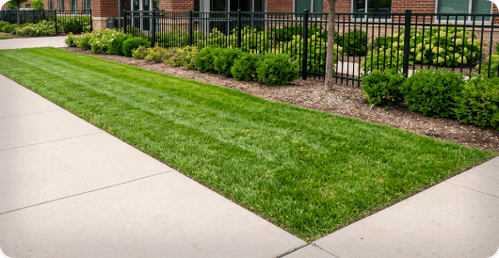
Border Strips
Decorative lawn along sidewalks, building edges, or fences.
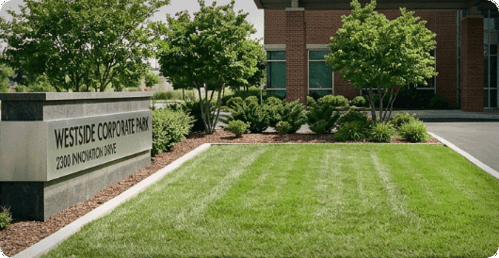
Entry Patches
Unused patches near signage or building entries.
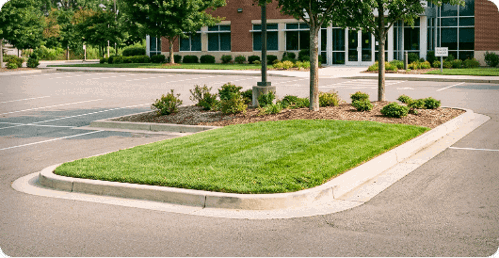
Medians & Islands
Lawn in medians, roundabouts, parking lots, or entry zones.
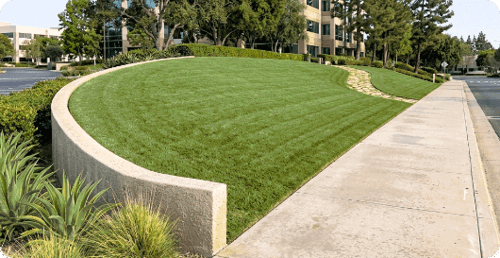
Slopes
Sloped lawn areas.
Compliance Timeline
Review the timeline below to understand who is affected and when.

Beginning January 1, 2027
Properties owned or leased by the Department of General Services (state government) and other state and local government properties must discontinue the use of drinking water on nonfunctional turf.

Beginning January 1, 2028
The ban extends to commercial, industrial, and institutional properties, including business parks, hospitals, educational campuses, and similar locations.

Beginning January 1, 2029
Common areas of homeowners’ associations (HOAs), common interest developments, and community service organizations or similar entities must comply with the prohibition.

Beginning January 1, 2031 (or later)
The ban applies to local government-managed properties located in disadvantaged communities (DACs), but only once state funding becomes available to support the transition.
What to Do
Identify & document turf areas
- Walk the site and list each turf area (photos + rough sq ft)
- Note which irrigation zone serves it and whether it’s likely drinking water
Confirm if it’s nonfunctional
- For each area: is it regularly used for recreation/community purpose?
- Tag areas: Likely Nonfunctional / Possibly / Likely Functional
- Prioritize “quick wins” (medians, strips, decorative entry patches)
Plan the replacement
- Choose the replacement approach (water-wise landscape goals + maintenance expectations)
- Create a simple phased plan (design → budget → approvals → contractor)
- Align irrigation to the new landscape (avoid keeping “turf irrigation” for non-turf)
Convert, adjust, and maintain
- Implement conversion in phases
- Update watering schedules/controller settings + maintenance scope
- Keep documentation (before/after photos + scope + dates)


FAQs
California's nonfunctional turf requirements apply to commercial, industrial, and institutional properties, public agency landscapes, and common areas managed by homeowner associations, common interest developments, community service organizations, and similar organizations. This law doesn’t apply to residential properties.
Properties subject to the law must discontinue using drinking water to irrigate nonfunctional turf by their applicable compliance date.
The compliance date is the date by which drinking water can no longer be used to irrigate nonfunctional turf. Landscape conversion doesn’t have to be completed by that date, but early action is recommended to give time to plan and make changes at a comfortable pace.
Trees should continue to be protected during the transition. When planning irrigation or landscape changes, develop a strategy that allows existing trees to receive the water they need without continuing to irrigate the surrounding nonfunctional lawn.
Potential alternatives include low-water native and water-wise plants, flowering shrubs, rain gardens, bioswales, paths, benches, and shaded gathering or seating areas.
The change is intended to reduce the use of drinking water on ornamental lawn that does not serve a recreational or community function, while preserving green spaces that provide a meaningful purpose and encouraging more efficient water use.